






.png)










.png)







BREAKING NEWS
Vizhinjam port automates growth path
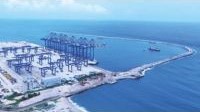
The Adani Group-run Vizhinjam International Deepwater Multipurpose Seaport, near Thiruvananthapuram in Kerala, is rapidly automating the core of its container and ship handling operations.
India's youngest and first dedicated container transshipment port achieved full capacity utilisation of 1.2 million twenty-foot equiva-lent units (TEUs), handling over a lakh con-tainers a month, in its first year of operations. This was possible thanks to advanced technology for container and ship handling operations.
In May 2024, Prime Minister Narendra Modi inaugurated the terminal. Over the past year, the terminal handled over 380 container ships, including MSC Irina, the world's largest container ship.
Manual vs automation
Typically, at a container terminal in any port, an operator is seated in the small cabin of a shore crane (also known as a container crane or wharf crane), perched 30-50 m above the pier or wharf to get a clear view of the lifting area below. The operator, with eyes glued to the ground be-low, loads boxes from the ships parked alongside the berth and unloads them on to trucks on the wharf, and vice versa. The operator keeps mov-ing to and fro along the boom and handles, on average, 25 moves per hour.
But at Vizhinjam terminal, Anirudh (name changed) does all this from an air-conditioned control room, using joy sticks and an array of screens in front of him. There are more than 25 employees, including a few women, working alongside him, ensuring seamless container handling 24/7, says a company spokesperson.
On the other hand, remaining seated alone in the cabin of a crane for nearly 8-10 hours could be stressful. After clocking 30-35 moves in the first two hours, productivity inevitably slows down. In contrast, in the comfort of the control room, productivity remains consistent through the day. There is no sense of isolation either, since the cabin is filled with other colleagues, he adds.
The port has commissioned eight quay cranes, which are operated re-motely from the control room; 20 fully automated cantilever rail-mounted gantry cranes handle container operations without need for a human operator. The container handling automation systems have been deployed by ABB systems, a world leader in this field.
For monitoring and controlling ship operations, an advanced digital twin system is used, which automatically collects and assimilates ma-chine and operational events using IoT systems in real-time on a large 3D video wall, enabling the controllers to be proactive in responding promptly to operational exceptions.
The automation systems at the port significantly increase operational safety and boost the scalability and consistency of operational perfor-mance, resulting in an enhanced customer experience for leading inter-national shipping lines, the spokesperson says.
The port has also adopted an advanced sensor and radar-based technol ogy, along with artificial intelligence, to track, coordinate and manage large container ships that dock and then depart after unloading.
Vessel traffic
As part of a comprehensive vessel traffic services initiative, the port has established a vessel traffic management system (VTMS), aimed at reduc-ing ship turnaround time, increasing capacity and enhancing naviga-tional safety. The centralised control room collects, processes and dis-plays the data, with further scope for using Al tools. As part of the 'Aatmanirbhar Bharat' drive, the software was developed indigenously by an IIT-Madras start-up, the spokesperson says.
Using radar and other sensors, the VTMS tracks ships approaching the port, providing real-time location data and tracking updates of nearby vessels. This helps in optimising port traffic flow and berthing assignments.
The control room receives real-time ship data through the automated integration of radar, automated identification system (AIS), CCTV, VHF communication and weather stations. This information is displayed on an electronic chart overlay for comprehensive traffic visibility. The weather system includes a tide gauge and monitors waves and currents. which are crucial for mitigating swell risks, given the port's vulnerabil-ity to such conditions, he adds.
The automation system enables operators to pre-determine an evolving scenario and perform optimally to ensure consistent productivity. Today, the only missing pieces in automation are manually driven trucks. These, too, will be automated in the future, he says, significantly reducing instances of errors and accidents.
Globally, remote crane operations at container terminals often face challenges due to partial automation and stringent safety protocols. True success hinges on fully automating horizontal yard operations, such as inter-terminal vehicles (ITVs), through driverless systems like automated guided vehicles (AGVs).
Vizhinjam port's level of ITV automation remains unclear in this con-text, says a global consultant who works with major ports.
Source: The Hindu Business Line
#theshippingtribune #latestnews #shippingnews #dailynews #Maritimenews #shippingindustry #news #media #newsupdate #maritime #shippingnewsworldwide


Comments